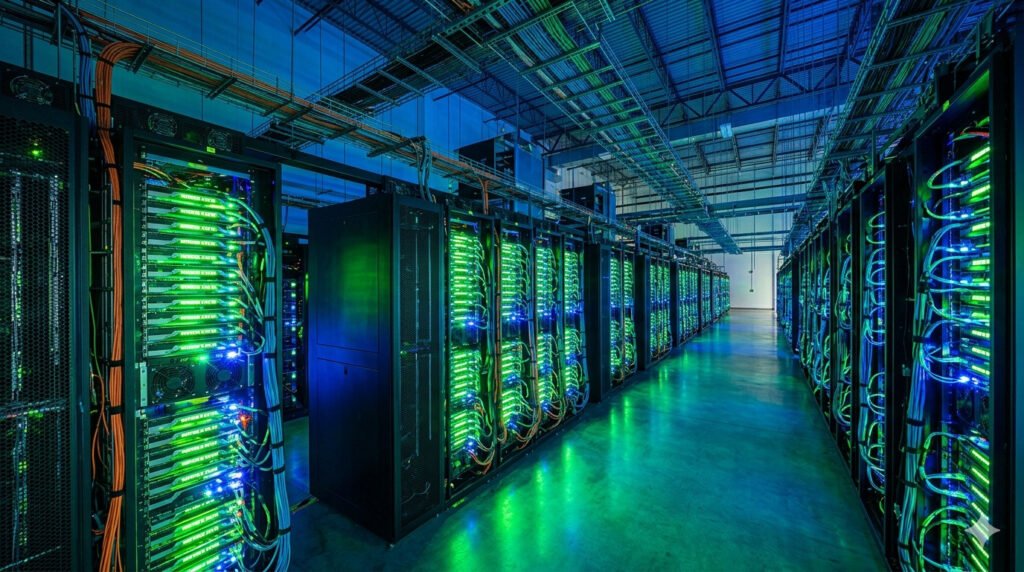
Physics at Scale experiments of CERN generate data at rates and in volumes that stress conventional IT architectures. Building and operating infrastructure for particle physics requires a long-term focus on throughput, determinism, and cost efficiency. This paper examines the technical evolution from early Grid computing to modern distributed systems that combine edge, cloud, and AI infrastructure.
Evolution from Grid Computing to Modern Distributed Systems
Grid computing provided a distributed fabric that federated compute and storage on a trust model suitable for academic collaborations. It solved authentication, job brokering, and bulk data transfer at a time when single data centers could not scale to scientific needs. The architecture favored batch workflows, replicated datasets, and predictable throughput over latency-sensitive interactions.
As network capacity, virtualization, and containerization matured, designs shifted toward cloud-native patterns. Cloud platforms introduced API-driven resource provisioning, software-defined networking, and object storage with eventual consistency models. These capabilities reduced friction for developers and enabled elastic scaling, but they required rethinking data placement and cost models for long-running scientific workloads.
Today, the system landscape includes edge computing and specialized AI accelerators. Edge sites sit close to detectors to pre-process or filter event streams, reducing upstream bandwidth. Central facilities and public clouds host large-scale simulation and long-term archives. AI infrastructure sits across that continuum, combining low-latency inference at the edge with high-throughput training in GPU and TPU clusters.
| Characteristic | Grid | Cloud | Edge | AI Infrastructure |
|---|---|---|---|---|
| Primary model | Federated HPC | On-demand services | Local preprocessing | Accelerator clusters |
| Data pattern | Bulk transfer | Object/stream | Low-latency slices | High-bandwidth I/O |
| Typical workload | Batch jobs | Mixed batch/interactive | Filtering, reduction | Training, inference |
CERN Use Cases: Edge, Cloud and AI Infrastructure
CERN operates a multi-tier distributed platform that reflects the need to balance centralization and locality. Detectors generate raw events at rates that exceed what long-distance networks can carry without reduction. Edge processing reduces data volumes by applying real-time triggers, lossless compression, and initial reconstruction steps at the detector site.
Public and private cloud resources complement on-premises capacity for elastic workloads and bursty simulations. CERN has used cloud capacity to process Monte Carlo simulations and reprocess datasets when on-site clusters are saturated. Cloud resources also support collaborative notebooks and machine learning experiments that benefit from managed services and specialized hardware.
AI increasingly augments both edge and centralized stages. Lightweight neural networks run on FPGA or GPU inference nodes at the edge to flag events of interest. At scale, training occurs on dense GPU or TPU farms where high-speed interconnects and parallel file systems sustain multi-petabyte datasets. The operational challenge is to orchestrate data movement, scheduling, and versioning across these layers while controlling cost and reproducibility.
Architecture Principles for Physics at Scale
Prioritize data locality based on workflow access patterns rather than topology alone. Identify hot datasets and co-locate compute where possible to reduce cross-site transfers. Use a tiered storage design so that high IOPS storage supports active analysis while cold archives live on higher-latency, lower-cost media.
Build deterministic network behavior into the design. For experiment controls and data acquisition, reserve bandwidth and apply quality of service rules. For bulk transfers, use parallel TCP or specialized protocols that maximize throughput over long fat networks while monitoring packet loss and latency closely.
Adopt strong abstractions for resource management: resource pools with quotas, clear SLAs, and immutable infrastructure for compute and storage nodes. Container orchestration and declarative provisioning simplify reproducibility. Combine those with policy-driven automation to enforce data retention, placement, and access control at scale.
Data Management and Transfer
Effective data management starts with consistent metadata and provenance. Capture origin, calibration, and processing steps at ingestion so downstream analysis can reproduce results. Use schema validation and lightweight catalog services to keep metadata usable at petabyte scale.
For transfers, instrument pipelines with continuous metrics: throughput, errors, latency, and retransmits. Implement parallel streams and checksums to maximize utilization of long-haul links. When possible, prefer scheduled bulk windows for large dataset movement and reserve incremental syncs for smaller, latency-sensitive updates.
Replication strategy should balance availability, cost, and analysis locality. Keep multiple replicas of the most accessed datasets close to compute clusters. Move less used datasets to tape or cold object stores with a predictable restore path. Automate lifecycle transitions to avoid manual intervention when usage patterns change.
Security, Compliance, and Governance
Security must be layered and measurable. Use strong identity federation and short-lived credentials for cross-institution access. Apply least privilege and role-based controls to services and data stores. Log authentication and authorization events in a centralized system for audit and anomaly detection.
Data governance requires clear policies for data classification, retention, and sharing. Define who can move, process, or publish datasets and enforce these rules through code and infrastructure. Maintain provenance and change logs to support reproducibility, regulatory obligations, and scientific review.
Operational resilience depends on planned failure modes and regular drills. Test disaster recovery for both compute and archive tiers. Validate assumptions about recovery time objectives and recovery point objectives using simulated failures and restoration exercises.
Implementation Roadmap
Adopt an incremental approach that validates each technical assumption. Start with a pilot that integrates an edge preprocessing node, a private cloud pool, and a central catalog. Use this integration to measure end-to-end latency, throughput, and operational overhead.
Scale the pilot by automating provisioning, telemetry, and policy enforcement. Add workflow orchestration to manage end-to-end pipelines from data acquisition to analysis and archive. Introduce containerized workloads and experiment with accelerator allocation for AI training.
Standardize interfaces and APIs to enable federation across sites. Implement common metadata schemas and transfer protocols. Formalize SLAs, capacity planning, and cost attribution models so stakeholders can plan experiments reliably.
Roadmap steps:
- Define requirements and KPIs for throughput, latency, and availability.
- Deploy edge preprocessing pilot at one detector site.
- Integrate a private cloud pool for burst compute and test autoscaling.
- Implement centralized metadata catalog and transfer instrumentation.
- Add accelerator-backed training cluster and benchmark workloads.
- Automate policy-driven data lifecycle and quota controls.
- Expand federation to external sites and public cloud providers.
- Conduct periodic DR and compliance validation exercises.
FAQ
This section addresses frequent technical questions from operations and engineering teams. The answers focus on implementation trade-offs and measurable outcomes.
Q: How do we decide what runs at the edge versus in the cloud?
A: Base the decision on bandwidth cost, latency sensitivity, and compute footprint. If pre-processing reduces data volume by an order of magnitude and must execute within detector timing constraints, run it at the edge. If workloads are highly parallel and tolerant of higher latency, prefer cloud or central clusters.
Q: Which storage medium should hold raw events?
A: Use fast, durable storage with good write throughput for raw ingestion, typically an on-premise object store or parallel file system. Move older raw events to tape or cold object storage based on access frequency. Ensure checksums and provenance persist through transitions.
Q: What is the best way to manage GPU allocation for training jobs?
A: Schedule GPUs via a cluster manager that supports resource isolation and backfill. Use quotas and priority classes for production training versus exploratory experiments. Instrument utilization and energy metrics to optimize packing and reduce idle GPU hours.
Q: How do we ensure reproducibility across heterogeneous infrastructure?
A: Rely on container images, versioned data snapshots, and declarative workflow definitions. Store environment manifests and random seeds in metadata. Automate environment reconstruction and include provenance for each analysis result.
Distributed computing for large-scale physics has moved from federated Grid systems to a hybrid model that blends edge preprocessing, cloud elasticity, and AI acceleration. Engineering choices now emphasize data locality, deterministic networking, and automated governance to meet the stringent requirements of modern experiments.
The practical roadmap and principles outlined here offer a path to deploy resilient, cost-effective infrastructure that supports both legacy batch workloads and emerging AI-driven pipelines. Continued investment in telemetry, metadata, and reproducible operations will keep these systems adaptable as scientific requirements evolve.