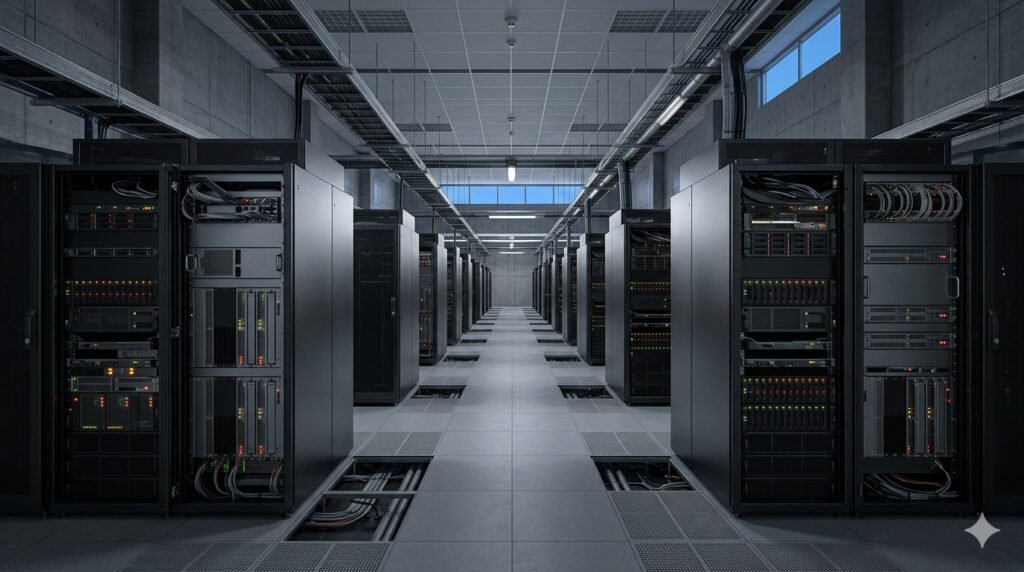
Legacy data centers require targeted structural and cooling modifications to host high-density GPU clusters, and retrofits must reconcile rack power, floor loading, and chilled water interfaces. The operational objective centers on converting rack-level constraints into predictable, measurable capacity upgrades that support racks drawing 40 kW to 300 kW per rack depending on the enclosure and liquid distribution chosen. Execution requires coordinated civil, electrical, and mechanical changes with vendor-certified rack enclosures and validated thermal models.
Retrofitting Legacy Data Centers for GPU Density
Existing Structural Limits
Data indicates most enterprise shells from 2010 to 2020 target 3 to 10 kW per rack, which fails for contemporary multi-GPU servers where per-server consumption reaches 5 to 10 kW and dense pods exceed 150 kW per rack. Retrofits must address raised floor load ratings, slab penetrations for chilled water, and power busway upgrades to mitigate feeder losses and voltage drop across racks. Site engineers must validate floor loading, plan mechanical penetrations, and stage structural reinforcement to avoid production-level surprises during rack installation.
Retrofitting Strategies
Architectural reality requires a tiered approach: pilot a single aisle with direct-to-chip or immersion-ready racks, validate cooling coefficients of performance, then scale in 10 to 20 rack blocks to limit risk exposure. Project timelines compress when teams prequalify vendors for modular rear-door heat exchangers, rear-door liquid coolers, or single-phase immersion solutions that map to existing chilled water plants. Procurement must specify rack PUE impact, per-rack kW rating, and factory acceptance test criteria, while the infrastructure team secures interlock modifications and cable-management plans.
The briefing below situates retrofit tactics within 2026 constraints, including component scarcity, tighter utility caps, hyperscaler egress economics, and regulatory audit expectations.
Hybrid Liquid-Air Cooling Integration and ROI
Hybrid liquid-air cooling integrates liquid heat transport with air-side distribution to deliver high thermal capacity while preserving failover air paths. The integration reduces sensible load on CRAC units, lowers facility delta-T, and allows GPU nodes to sustain higher average utilization without thermal throttling. Quantitatively, validated pilots show 25 to 50 percent reduction in chiller load versus high-density air-only deployments, improving effective compute per megawatt.
System Architecture
Hybrid architecture couples rear-door or rack-level cold plates to a plant-loop or closed-loop distribution, while maintaining room air for secondary cooling, smoke control, and emergency ventilation. Design choices include single-phase liquid cooling with heat exchangers, versus two-phase or immersion for the highest densities, each influencing plumbing complexity and leak management. Integrators must specify fluid type, flow rates, delta-T, and containment strategy, and must insist on PCIe/NVLink airflow preservation and cable routing to avoid hot spots.
Business Case & ROI
Financial models must combine capital for chillers, distribution manifolds, and pump skids with operational savings from lower chiller runtime and improved compute density per square foot. Typical internal-rate-of-return scenarios for hybrid retrofits close within 24 to 48 months when rack power density exceeds 30 kW and when utilities charge >$0.10/kWh plus demand charges. FinOps should budget contingency for switchgear upgrades and test-failure remediations, as unforeseen electrical redesigns account for a common 12 to 18 percent schedule and budget delta.
Strategic Takeaway: Prioritize retrofit pilots that validate a minimum of 30 kW per rack and demonstrate measurable reductions in chiller duty cycle.
Thermal and Power Infrastructure Upgrades
Thermal and power upgrades represent the gating factors for density; without properly sized distribution, GPU clusters will force throttling or outages. Facilities must evaluate transformer capacity, medium-voltage gear, and switchgear headroom, while modeling harmonics and inrush behavior from GPU-rich power supplies. Engineering teams must model peak power draw, simultaneous power utilization factor, and generator sizing to ensure N+1 or 2N targets.
Power Delivery and Distribution
Upgrade options include distributed busway systems rated for 400 A to 1200 A per segment, localized power distribution units with remote monitoring, and upgraded UPS strings sized for high short-term peak currents associated with GPU boot storms. Electrical designs must include coordinated protective device curves to prevent nuisance trip events under high transient loads experienced by large GPU clusters. Budget accordingly for transformer swaps, power factor correction, and additional metering for per-rack telemetry.
Cooling Capacity and Redundancy
Cooling capacity planning must assume sustained steady-state heat transfer plus transient margins for workload peaks, with facility-level redundancy matching business continuity requirements. Implement modular pump skids with variable-frequency drives and dual-path manifolds to maintain flow under component failure while sustaining ΔT specifications necessary for heat rejection to existing chillers. Validation requires empirical thermal mapping, and contingency design must include room air recirculation fallback with capacity to sustain minimum safe compute for emergency operations.
Network and Fabric Considerations for High-Density GPUs
High-density GPU deployments change the networking profile: east-west traffic increases dramatically, and fabric congestion directly degrades model training timelines and SLA delivery. Enterprises must provision low-latency fabrics with high bisection bandwidth, favoring InfiniBand HDR/Next-Gen 400GbE for clustered training and provisioning deterministic QoS for multi-tenant environments. Switch port density, leaf-spine oversubscription ratios, and cabling logistics become physical constraints during retrofit.
Spine-Leaf and Fabric Topologies
Architectural reality requires non-blocking or low-oversubscription spine-leaf topologies with scalable spine capacity to avoid future forklift network upgrades as GPU counts increase. For multi-rack GPU pods, place leaf switches at rack pairs or small clusters to minimize copper runs and support RDMA and GPUDirect traffic patterns. Budget for redundant spine switches, and specify port speeds and buffer depth in vendor SLAs to match worst-case all-to-all training patterns.
Cabling, Copper/Optical, and RDMA
Cabling choices affect airflow, aisle containment, and serviceability. Short, high-density copper runs serve within-rack connections, while optical trunks handle spine aggregations to reduce heat and congestion in the aisle. Explicitly test and standardize on SR/DR optics and certified RDMA-capable NICs per server to avoid late-stage interoperability issues that surface during scaled validation. Document cable management and port labeling in acceptance criteria to reduce rack swap time during maintenance.
Operational, Safety, and Compliance Controls
Operational rigor and safety systems become more complex with liquids co-located to high-voltage equipment, and governance must address leak mitigation, EHS procedures, and regulatory audit flows. Implement layered leak detection, automated isolation valves, and clear SOPs for emergency power-down that protect personnel and compute assets. Compliance plans must map fluid inventories, dielectric properties, and environmental reporting to local codes and data protection regulations.
Leak Detection and Safety
Detect leaks early using differential pressure monitoring, optical or liquid sensors at planned drip trays, and flow/temperature anomaly detection at rack and manifold levels. Pair detection with automatic isolation and safe-shutdown interlocks which isolate affected rack zones without causing collateral outages. Train operations for rapid containment and safe component replacement, and include PPE and spill-response kits compatible with the chosen coolant.
Compliance and Auditability
Regulatory compliance requires documenting mechanical penetrations, updated single-line diagrams, and environmental impact assessments where new fluids or refrigerants appear in scope. Data center security controls must extend to physical lockouts, tamper-evident conduits, and audit trails for any work performed on chilled-water or pump systems. Maintain vendor certificates for rack-level equipment and test reports to prove thermal performance during audits and insurance reviews.
Deployment Roadmap and Financial Modeling
Phased rollouts reduce financial and operational risk while building internal expertise, and financial models must reflect staged capital draws and measured performance milestones. Execute a pilot, expand to production phase blocks, and complete a campus-scale rollout only after validated reliability targets. CFOs and FinOps teams must align OPEX forecasts with anticipated PUE improvements and lease or financing options for high-cost modular components.
Phased Rollout and Pilot
Structure pilots as 8 to 16 rack clusters instrumented with telemetry for power, inlet/outlet temperatures, flow rates, and application-level performance to create a defensible dataset for board-level decisions. Use pilot results to tune manifolds and control logic, then apply orchestration templates for rack commissioning to standardize subsequent installs. Ensure each phase contains rollback plans and spare capacity to absorb failed nodes without disrupting production.
Cost Modeling and Funding
Model capital expense lines for switchgear, chillers, manifolds, and specialized racks against operational savings from improved PUE and increased compute density per floor. Include depreciation schedules aligned to vendor warranties and expected hardware refresh cycles, and size contingency reserves for electrical unknowns typically amounting to 10 to 20 percent of retrofit capital. Consider performance-linked financing or vendor-managed deployments where available to transfer execution risk and align incentives.
Hybrid Cooling Scorecard
| Feature | Metric / Threshold | Impact Score (1-10) |
|---|---|---|
| Rack Power Density | 30 kW / rack minimum | 9 |
| Cooling Efficiency (ΔChiller) | >25% chiller duty reduction | 8 |
| Network Fabric | 400GbE or InfiniBand HDR | 9 |
| Electrical Upgrade Complexity | Transformer or busway required | 7 |
| Deployment Payback | 24-48 months | 8 |
FAQ
What happens to network debugging when GPUs are in liquid-cooled racks with limited physical access?
Liquid-cooled racks constrain on-rack access and lengthen mean-time-to-repair unless remote telemetry is comprehensive. Ensure per-port diagnostics, out-of-band management, and hot-swapable fanless NIC modules where possible, and define SOPs for safe ingress with isolation valves to allow controlled service windows without full system depressurization or coolant exposure.
How should an enterprise manage single points of failure introduced by pump skids and manifolds in hybrid systems?
Design for N+1 redundancy on pump skids and dual-path manifolds, and implement automatic failover with cross-tied control logic that isolates failed pumps while maintaining flow to critical racks. Validate failover in staged tests and instrument manifold pressure and flow meters to detect partial degradations that precede full failure.
How do you qualify GPU vendor warranties when retrofitting with direct liquid cooling or immersion?
Vendors vary in warranty coverage when liquid interfaces replace air cooling, so require written OEM endorsements or factory integration certificates as procurement preconditions. Build FAT criteria that include thermal cycling and ingress protection verification to protect warranty claims and ensure interoperability with accessory controllers.
How should capacity be billed in colo or multi-tenant retrofits with hybrid cooling to avoid cost leakage?
Charge tenants by effective usable kW and not by gross rack footprint, accounting for cooling distribution inefficiencies and shared plant load, and provide transparent metering for inlet power, flow, and temperature to reconcile billable capacity. Apply differentiated rates for burstable capacity and reserved SLA-backed lanes to preserve fairness and finance predictability.
What are the primary failure modes for RDMA fabrics co-located with liquid manifolds, and how to mitigate them?
Primary failure modes include cable overheating from constrained airflow, connector corrosion in humid environments, and contamination during service. Mitigate via sealed optical trunks, humidity control, and rigorous ingress protection procedures during maintenance, and ensure path diversity to prevent single-trunk failures from impacting cluster training jobs.
Conclusion: Hybrid Liquid-Air Cooling: Retrofitting Legacy Data Centers for High-Density GPU Hardware
Hybrid liquid-air retrofits deliver measurable density gains and operational savings when engineered to match legacy constraints, and the execution requires precise coordination across facilities, network, and procurement teams. Strategic rollout via pilots and standardized commissioning reduces technical risk and provides empirical ROI data for board-level investment approval. Prioritize vendor-certified racks, validated thermal models, and robust electrical upgrades.
Strategic Takeaways
Scale decisions pivot on three vectors: per-rack kW capacity, network fabric bandwidth, and electrical headroom, and infrastructure owners must lock these metrics before procurement. Finance must model capital drawdowns against 24–48 month payback windows and allocate 10 to 20 percent contingency for electrical or structural surprises. Operations must enforce telemetry, leak detection, and failover testing as acceptance gates.
Technical Forecast
Over the next 12 months, expect widespread adoption of hybrid liquid-air approaches for any retrofit targeting greater than 30 kW per rack, incremental industry standardization around 400GbE and RDMA for GPU fabrics, and tighter integration between infrastructure vendors and GPU OEMs for warranty alignment. Utilities will increase scrutiny on demand peaks, making workload shaping and energy arbitrage strategies standard in enterprise planning for high-density GPU deployments.
Tags: hybrid-cooling, liquid-cooling, data-center-retrofit, high-density-gpu, power-infrastructure, thermal-management, network-fabric