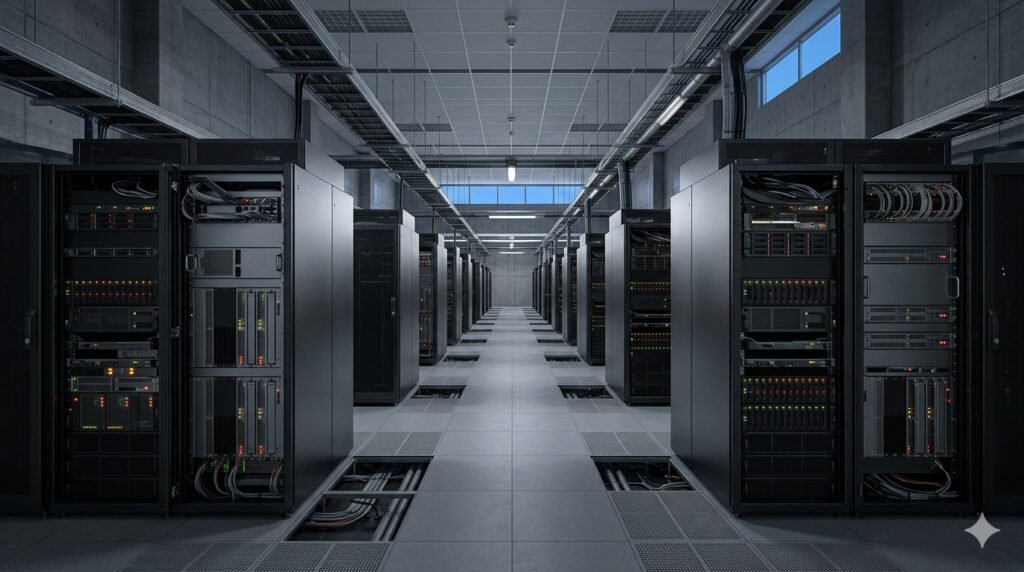
Automated node recovery must operate as a deterministically orchestrated subsystem to keep long-running training jobs uninterrupted and within SLA budgets. Architectural reality requires automated detection, state-preserving checkpointing, and progressive rehydration strategies that minimize lost GPU-hours while preserving convergence trajectories for large transformer and diffusion models. The decision vector balances hardware redundancy, checkpoint cadence, and network fabric latency to control both model accuracy risk and run-to-completion cost.
Detection and Fast-Fail Containment
Failure detection must combine low-latency telemetry, heartbeat anomalies, and cross-layer consensus to prevent false positives and noisy recovery loops. Implement a multi-tier watchdog that correlates ASIC telemetry, NIC port state, and power distribution telemetry to isolate node-level faults in under 30 seconds without triggering cluster-wide rebalancing. The operational goal ties detection fidelity to an SLO: under 1% unnecessary preemption events per month.
Stateful Checkpointing and Warm-Pooling
Preserving model state requires incremental, ML-aware checkpoints that separate optimizer state, sharded parameters, and transient data so replacement nodes can rehydrate without full cold restart. Use layered storage: local NVMe for ultra-fast differential checkpoints, distributed erasure-coded object storage for resilience, and selective in-memory replication of critical tensors for low-loss hot swaps. This reduces recompute time by measurable fractions on mixed-precision training runs and improves GPU utilization.
The briefing synthesizes fault-tolerant node recovery and replacement strategies for enterprise grid operators, framed for board-level infrastructure decisions and technical RFPs.
Seamless replacement operates as a choreography between scheduler policies, fabric-wide state, and node provisioning workflows that sustain training momentum. Operational controls must shift from coarse VM restarts to fine-grained GPU slot orchestration, allowing partial node replacement and live GPU reassignment without breaking distributed optimizer consensus. Financial and energy inputs change materially when replacements avoid full job restarts.
Hot Swap Workflows and Scheduler Integration
Schedulers must natively understand GPU topology and fractional slot allocations to remap tasks to warm-pool instances with minimal parameter synchronization overhead. Integrate scheduler hooks with checkpoint registries and RDMA-capable fabric to replay the last consistent checkpoint across fewer RTTs and resume gradient accumulation without loss. The scheduler policy should prefer local rack replacements to minimize cross-rack bandwidth consumption and preserve gradient all-reduce performance.
Question: How do you handle a partial GPU-device failure without restarting the full data-parallel job?
When a GPU shows intermittent ECC errors but device remains addressable, implement device-level evacuation by draining active micro-batches and migrating remaining tensors to a warm spare using NVLink or NVMe-backed staging. The orchestrator must enforce tensor consistency checks and resume with adjusted local batch sizes while logging an actionable incident that triggers hardware-level replacement within the established maintenance window. This containment preserves convergence and limits epoch-level variance.
Operational telemetry must translate raw sensor streams into a health score that drives automated recovery thresholds and replacement economics. The control plane needs normalized metrics across vendors, including power draw, junction temperature variance, ECC event rates, PCIe error counts, and NIC microburst patterns, to compute a deterministic risk index for each node. The data suggests prioritizing nodes by expected remaining useful training hours to minimize wasted compute credits and expedite replacements.
Health Scoring and Predictive Replacement
Compute a composite health score that weights immediate recovery cost against projected training disruption cost, using a rolling 1, 6, and 24-hour forecast horizon to trigger either on-demand replacement or deferred scheduled maintenance. Feed the score into the scheduler to order replacements by marginal cost per GPU-hour saved, balancing bin-packing efficiency against failure risk. This method reduces unplanned downtime and improves capacity planning accuracy.
Question: What telemetry signals most reliably predict imminent node failure for large-scale trainers?
Correlated increases in ECC correction counts alongside rising junction temperature variance and intermittent PCIe resets provide the highest predictive value for imminent GPU failure, when observed over a 6-24 hour window with a rising trend. Combine hardware counters with NIC port error clustering to disambiguate cooling-induced versus silicon degradation failures, enabling preemptive warm-pool activation and minimizing lost training progress.
Network fabric resilience and thermal-aware scheduling determine whether replacements remain local or force cross-rack redistribution, directly affecting training throughput and tail latency. Architectural reality requires fabric-level QoS, congestion avoidance, and thermal zoning to keep all-reduce times within model SLOs during node recovery events. The deployment must align with rack-level cooling gradients and switch ASIC oversubscription profiles to avoid hidden throttles that extend run times.
Congestion-Control and RDMA Path Redundancy
Implement path-aware RDMA routing and ECN-based congestion control tuned for all-reduce patterns to avoid head-of-line penalties during rebalancing and replacement. Maintain redundant ROCEv2 or NVMe-oF paths with deterministic failover to preserve transfer latencies while recovery copies stream checkpoint deltas. The fabric policy should enforce priority lanes for urgent state rehydration to limit stragglers and preserve training wall-clock time.
Question: How does thermal-aware scheduling reduce replacement-induced performance degradation in dense GPU racks?
Thermal-aware schedulers place replacements into racks with spare cooling capacity and lower upstream switch utilization, limiting thermal throttling and PCIe link error rates that add latency to collective ops. By modeling cooling zones and expected TDP profiles, the scheduler avoids placing hot-spare nodes into already thermally stressed racks, preserving effective FLOPS and reducing the probability of replacement-triggered secondary failures. Strategic Takeaway: prioritize rack-level thermal headroom in replacement policies.
Financial modeling must quantify the trade-off between on-hand spares, warm-pool sizing, and cloud egress or preemption costs to produce defensible budget allocations. The CFO and FinOps partners need a probabilistic spend forecast that maps failure rates to GPU-hour loss, spare inventory carrying costs, and the premium of immediate replacement versus deferred scheduled repair. The model drives the capital allocation for spare chassis, contract terms for hyperscaler spot vs reserved capacity, and the break-fix SLA levels to include in vendor RFPs.
Node Recovery Feature Scorecard
Budget allocation should include metrics-driven thresholds: expected annual GPU failures per 1,000 GPU-years, mean time to repair, and marginal cost per recovered checkpoint hour. The following scorecard informs procurement and operational decisions.
| Metric | Low Resilience | Standard | High Resilience |
|---|---|---|---|
| Expected GPU failures /1k GPU-years | 50 | 30 | 10 |
| Mean Time to Recovery (minutes) | 90 | 30 | 10 |
| Spare pool (% of fleet) | 2% | 6% | 12% |
| Marginal cost per recovered GPU-hour | $12 | $6 | $3 |
Question: How should enterprises balance spend between on-prem spares and cloud warm pools for uninterrupted runs?
Enterprises should model the marginal cost per GPU-hour, including capital amortization for spares and expected utilization, against cloud on-demand or spot premiums plus egress and rehydration latency penalties. For predictable, high-utilization training pipelines, a hybrid approach with 6-8% warm-pool on-prem plus burst-to-cloud contracts minimizes expected cost while keeping job completion risk within board-approved tolerance levels, given current 2026 market pricing.
Compliance and security must not be secondary during automated recovery, because live replacements increase attack surface and cross-tenant data exposure risk in multi-tenant grids. Architectural reality requires attested boot, secure enclave handoff of optimizer state if needed, and strict key management for checkpoint rehydration across replacement nodes. The risk model must quantify potential leakage windows and enforce cryptographic sharding for sensitive model weights.
Isolation, Attestation, and Keying
Require hardware root-of-trust attestation before any warm spare assumes a training role, and enforce ephemeral key provisioning for checkpoint decryption that expires post-session. Integrate workload-aware microsegmentation and TLS-enforced RDMA channels to prevent lateral movement during state transfers, and log every rehydration with immutable audit trails for compliance. This approach reduces regulatory and IP leakage risk while enabling automated operations.
Question: What are the edge-case risks when replacing nodes in multi-tenant, encrypted model training environments?
Edge cases include stale or misapplied key rotations where a replacement node lacks timely key provisioning, accidental snapshot exposure across tenants when erasure coding misaligns, and enclave provisioning failures that stall rehydration. Forensic mitigation requires per-session key escrow, atomic checkpoint transfers with provenance metadata, and automated rollback capabilities to prevent partial restores that could leak fragments of model state.
Conclusion: Fault-Tolerant AI Training: Automated Node Recovery and Replacement for Uninterrupted Model Runs
Automated node recovery and seamless replacement form a single control loop where telemetry, scheduler intelligence, fabric resilience, and financial rigor converge to preserve long-running model runs. Architectural decisions must quantify the marginal cost of spare capacity against potential GPU-hour loss and time-to-convergence variance, with enforcement at fabric, node, and cryptographic layers to reduce operational risk. The board-level commitment should fund measurable SLAs tied to those metrics.
Strategic Summary
Enterprises must set deterministic SLOs for detection latency, mean time to recovery, and marginal cost per recovered GPU-hour, and align procurement to meet those SLOs. Tactical investments in NVMe-tier incremental checkpoints, RDMA priority lanes, and a quantified spare pool reduce expected training disruption and provide predictable budget absorption for replacements and repairs.
Technical Forecast
Over the next 12 months, expect modest reductions in per-GPU failure rates as silicon maturity improves, but operational complexity will rise with heterogenous accelerators and denser racks, increasing the value of automated recovery orchestration. Financially, plan for a 5-12% budget allocation toward warm-pool and spare inventory management, and anticipate network upgrades to support prioritized RDMA lanes and reduced all-reduce tail latency.
Tags: fault-tolerance, AI-training, node-recovery, GPU-infrastructure, RDMA, FinOps, data-center-security