Particle physics experiments produce data at rates and complexity that force infrastructure teams to evolve beyond the original Grid model. This paper examines the hardware layers that underpin modern discovery and articulates how distributed systems, edge devices, cloud platforms, and AI processors integrate into a reliable research stack. I present concrete engineering considerations and an actionable roadmap for research institutions.
Core Hardware Layers in Particle Physics Stacks
The foundation of any particle physics stack is the detector front end and data acquisition hardware. Front-end electronics perform initial signal conditioning, digitization, and zero suppression. Engineers design these boards for radiation tolerance, real time determinism, and minimal power dissipation.
Above the front end sits the trigger and event builder layer. This hardware aggregates channels, performs pattern recognition or simple reconstruction, and selects events for persistent storage. Modern systems use FPGA farms and low-latency network fabrics to keep trigger decision times within defined budgets.
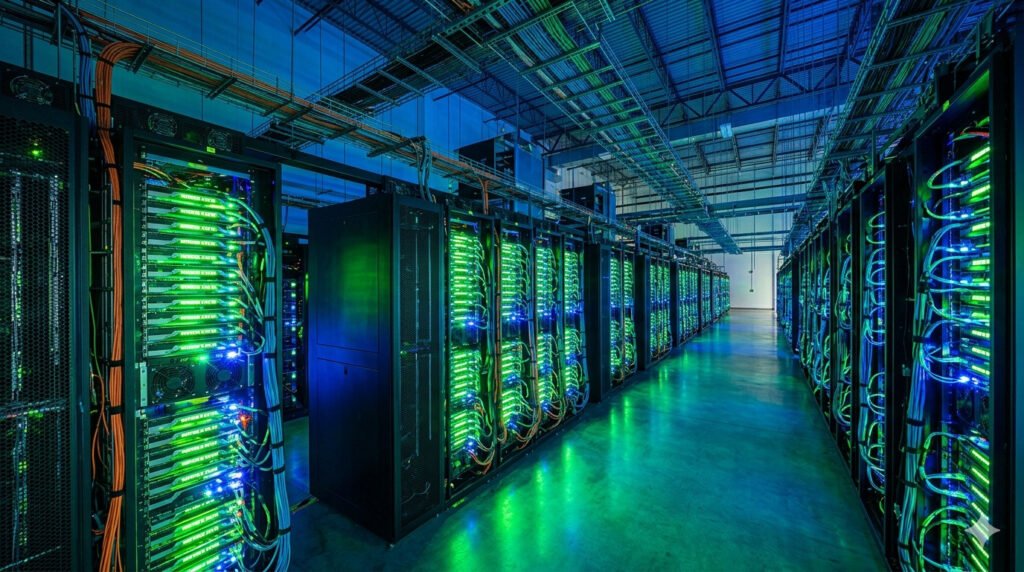
At the next layer storage and compute appliances ingest selected events for reconstruction and calibration. These appliances combine high IOPS NVMe arrays, CPU or GPU accelerators, and local fabrics that reduce data movement. Architects size compute to match reconstruction throughput and to give headroom for calibration cycles and reprocessing.
Networking, Storage, and Compute for Experiments
Networking must balance latency and throughput across three domains: detector edge, on-premise data centers, and wide area links. At the edge, engineers prioritize deterministic links and lossless fabrics to meet trigger budgets. For aggregation to on-premise computing, 100 Gbps and higher links with Quality of Service policies are common.
Storage architecture separates short term high performance layers from long term archival tiers. Short term layers use NVMe RAID or object stores with strong consistency for reconstruction and calibration. Long term archival uses tape libraries or cold object stores with cataloguing systems that provide reproducible access across centuries.
Compute mixes general purpose CPUs, GPU clusters, and specialized accelerators for inference and reconstruction. Teams optimize the software stack to exploit SIMD and tensor cores where appropriate. They also provision burst capacity from cloud providers for reprocessing peaks while maintaining predictable baselines on on-premise clusters.
Evolution from Grid Computing to Distributed Systems
The original Grid model emphasized federated resource sharing, batch processing, and data replication across campuses. It solved the problem of limited centralized capacity by pooling compute and storage across administrative domains. The architecture relied on robust middleware for job submission, data transfer, and authentication.
Modern distributed systems keep that federation but add dynamic resource provisioning and data locality awareness. Edge processing moves coarse selection and feature extraction closer to detectors. Cloud and AI accelerators handle episodic large scale processing and model training. This shift reduces unnecessary data movement and decouples throughput from physical site capacity.
The table below contrasts core attributes of classic Grid architectures and current distributed stacks.
| Attribute | Grid Computing | Modern Distributed Stack |
|---|---|---|
| Resource model | Static federation of clusters | Dynamic provisioned compute including cloud and edge |
| Data locality | Full replication across sites | Hierarchical locality with edge preprocessing |
| Orchestration | Batch schedulers and middleware | Container orchestrators and workflow engines |
| Latency | Optimized for throughput | Includes low-latency edge fabrics for triggers |
| Scaling | Manual and planned | Auto scaling with cloud and accelerator burst |
Edge, Cloud, and AI Integration in Analysis Pipelines
Edge integration shifts deterministic preprocessing to hardware near the detector. Engineers implement firmware pipelines that calibrate and compress waveforms, reducing data volumes by orders of magnitude. This reduces WAN pressure and enables faster feedback loops for detector operations.
Cloud platforms provide elastic capacity for Monte Carlo production and large reprocessing campaigns. When moving workloads to the cloud, teams quantify TCO, egress costs, and the performance characteristics of target instance types. A hybrid strategy keeps latency sensitive services on site and leverages cloud for batch intensive work.
AI integration requires both hardware and software co-design. Training uses mixed precision GPUs or specialized accelerators and demands fast storage and network topologies for dataset shuffling. Inference benefits from FPGA or ASIC deployments at the edge to meet real time constraints while minimizing power.
Reliability, Monitoring, and Security at Scale
Hardware reliability drives experiment uptime and data integrity. Teams adopt redundancy at the network, power, and storage levels and use predictive maintenance based on telemetry. Failure modes include bit flips in radiation exposed components and network microbursts that affect trigger performance.
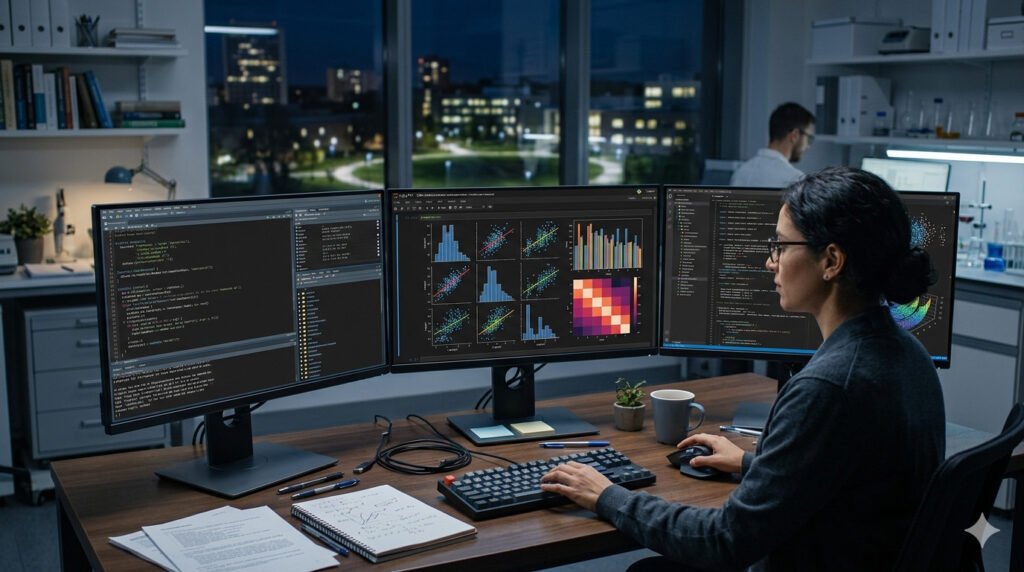
Monitoring must correlate hardware metrics with physics quality indicators. Instrumentation covers board level currents and temperatures, network error rates, and storage latency distributions. Engineers deploy anomaly detection for both hardware faults and drift in calibration constants that can corrupt downstream analysis.
Security protects data provenance and control planes. Operational controls include hardware attestation, compartmentalized network zones, and role based access for control systems. For multi-institution workflows, federated identity and policy enforcement maintain reproducibility while limiting attack surfaces.
Infrastructure Roadmap and Deployment Patterns
- Audit current hardware inventory and measure throughput, latency, and failure rates under real workloads.
- Define locality tiers and place preprocessing at the detector edge to reduce raw data egress.
- Standardize on containerized services and adopt an orchestrator that supports GPUs and bare metal scheduling.
- Deploy a multi-tier storage strategy: NVMe for hot, object stores for warm, and tape for cold archival.
- Integrate cloud providers for burst capacity and define data staging workflows to minimize egress.
- Add AI accelerators for training and inferences where they reduce end to end latency or cost.
- Implement comprehensive telemetry and predictive maintenance for hardware components.
- Establish security baselines including hardware attestation and federated identity across sites.
These steps reflect pragmatic sequencing. Start with measurement, then move data reduction to the edge, then modernize orchestration and storage. Cloud and AI capabilities come after operational baselines stabilize.
FAQ -The Particle Physics Stack
Q: How do teams choose between on-premise GPU clusters and cloud accelerators?
A: They quantify workload patterns. If training is continuous and latency sensitive, on-premise GPUs often lower cost per training hour. For sporadic large campaigns, cloud spot instances reduce capital expense. Include data movement and software licensing in the calculation.
Q: What metrics define acceptable network performance for trigger systems?
A: Teams set metrics for one way latency, jitter, and packet loss under peak load. Typical targets are microsecond level jitter control and sub millisecond deterministic paths. They verify those metrics with stress tests that simulate real burst patterns.
Q: How do you ensure reproducible analysis across distributed storage tiers?
A: Use immutable object identifiers, catalog versioning, and checksum verification. Archive software that captures environment state including container images and library hashes. Reprocessing pipelines should pin dataset and software versions.
Q: What is the role of tape archives in modern stacks?
A: Tape remains economical for long term retention of raw and processed datasets. It provides a stable store with predictable unit cost per byte. The challenge is ensuring catalog reliability and fast retrieval policies for active reprocessing.
Modern particle physics infrastructure blends proven Grid concepts with edge processing, cloud elasticity, and AI accelerators. Engineers must design hardware stacks that minimize data movement, maintain deterministic paths where required, and provide flexible compute and storage for peaks. Following a measured roadmap and enforcing strong monitoring and security yields predictable operations and supports future discovery.e.