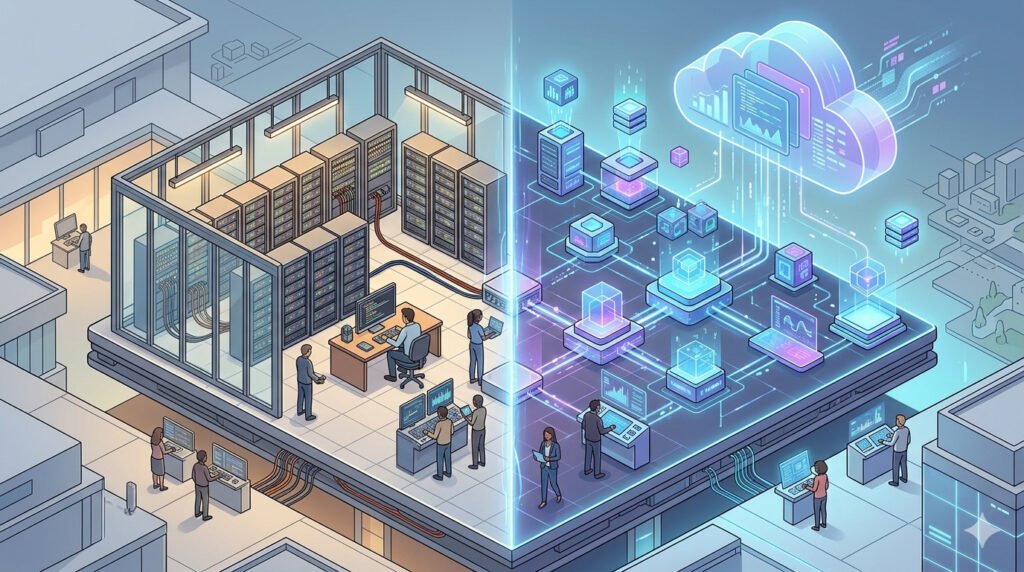
Digital twin strategy represents digital replicas of physical assets that run live simulations and analytics. For critical infrastructure and industrial systems, real-time fidelity matters. Infrastructure strategy determines whether a twin can meet latency, throughput and consistency targets in production.
This white paper traces the engineering path from classical grid computing to today’s distributed systems that combine edge compute, cloud services and on-prem AI accelerators. I focus on the practical design choices that enable live simulation, data integrity and operational resilience at scale.
Readers will find an actionable framework, a clear infrastructure design pattern and a phased roadmap that you can adapt to facility-level, city-level or utility-scale deployments. The recommendations reflect constraints that matter to architects: network characteristics, compute placement, state synchronization, and operational cost.
Strategic Framework for Real-Time Digital Twins
A strategy for real-time digital twins begins with explicit service level objectives. Define measurable targets: update frequency, end-to-end latency, state convergence window and tolerated data loss. For example, a distribution grid twin may require sensor-to-model latency under 100 milliseconds and a state convergence within 1 second during normal operation.
Next, map workloads to placement and scaling constraints. Partition computational tasks by temporal sensitivity: low-latency inference and control logic belong near the edge, while bulk training and long-horizon optimization reside in regional cloud or aggregated on-prem clusters. Choose compute fabrics that provide predictable performance, such as reserved CPU cores, explicit GPU scheduling or isolated real-time containers.
Finally, anchor the strategy with repeatable validation and telemetry. Instrument data pipelines to measure staleness, packet loss and processing jitter. Use synthetic load tests that mimic sensor bursts and network partition scenarios. Treat those telemetry signals as input to cost-performance tradeoff decisions, not as postmortem artifacts.
Infrastructure Design: Edge, Cloud and AI Integration
Design for locality first. Place streaming ingestion, immediate feature extraction and control loops at the edge to reduce round-trip delay and to limit bandwidth usage. Use light-weight runtimes that support model inference in containers or on-device accelerators such as FPGAs or dedicated NPUs when deterministic latency matters.
Integrate cloud services for cross-site aggregation, model retraining and long-term storage. Use regionally distributed object stores and time-series databases to collect historical telemetry. Ensure that cloud components provide predictable throughput by reserving capacity or using provisioned IOPS on critical storage paths.
Combine AI infrastructure with a clear training-serving split. Host training jobs on pooled accelerators in the cloud or private clusters and push optimized model artifacts to edge nodes using atomic, versioned deployment mechanisms. Include model health checks and canary rollouts to prevent degraded control behavior after model updates.
Evolution from Grid Computing to Modern Distributed Systems
Grid computing focused on batch parallelism across distributed nodes with high compute density and centralized scheduling. That model served well for throughput-driven workloads such as large simulations. However, it did not match the latency and locality constraints required by real-time monitoring and control systems.
Modern distributed systems introduce layered compute: edge nodes for low-latency tasks, regional clusters for intermediate aggregation and cloud for elastic compute. They add persistent streaming layers, service meshes for reliable routing and container orchestration for workload portability. Together these features enable the continuous update and execution loop that real-time digital twins require.
The practical result is a hybrid architecture that preserves the efficient resource sharing from grid-era systems while adding fine-grained placement and orchestration. Architects should treat grid computing as a conceptual ancestor and adopt the specific mechanisms required today: stateful stream processing, autoscaling with latency constraints and robust service discovery.
| Feature | Traditional Grid Computing | Modern Edge-Cloud Architecture |
|---|---|---|
| Latency focus | Batch oriented, high latency | Millisecond-level, locality optimized |
| Workload type | High throughput compute jobs | Mixed inference, streaming, training |
| Resource placement | Centralized scheduler | Layered placement: edge, region, cloud |
| Data movement | Bulk transfer | Stream-first, selective aggregation |
Data Pipelines and Synchronization
Build deterministic pipelines that control frequency and format of updates. Use typed telemetry schemas and versioned serialization to avoid silent incompatibilities. For high-frequency sensors, aggregate at the source using sliding-window summaries to reduce downstream load without losing control fidelity.
Implement state synchronization primitives that support eventual consistency with bounded staleness. Choose tools that expose explicit time semantics, such as time-series databases with built-in compaction and retention policies or stream processors that support windowed joins and exactly-once semantics. Where strict consistency is required for control, prefer consensus-based state stores and local locking primitives.
Design for graceful degradation. When network partitions occur, the edge should continue operating using local models and cached state. Ensure safe fallback strategies for actuation: conservative default behavior, limited control authority or human-in-the-loop escalation. Capture the divergence and reconcile state once connectivity returns.
Compute and Latency Management
Quantify latency budget by component. Break down the end-to-end path into sensing, transport, preprocessing, inference, actuation and acknowledgment. Allocate and enforce budgets at each hop. For example: sensing 5-10 ms, transport 10-30 ms, preprocessing 5-20 ms, inference 10-30 ms, actuation 5 ms.
Choose transport and network technologies that align with the budget. Use deterministic networking where available, traffic prioritization, or separate control VLANs. For regional aggregation, employ compression and batching with backpressure control. Consider RDMA or high-performance messaging for intra-cluster links when latency and throughput justify their operational complexity.
Right-size compute and memory for predictable performance. Use real-time kernels for critical tasks, pin CPU cores for low jitter, and isolate memory and I/O resources. Measure tail latency under realistic concurrent load; median and mean values hide outliers that will drive control instability.
Security, Governance and Operational Resilience
Treat security as part of the control loop. Use mutual TLS and signed artifacts for model deployment to prevent tampering. Implement strong identity and access controls for edge nodes and management planes to limit blast radius of compromised devices.
Establish governance for model lifecycle, data retention and provenance. Track model training data, version, and evaluation metrics. Maintain auditable trails that link actions taken by the digital twin back to model versions and sensor inputs. That traceability supports compliance and incident postmortem.
Bake operational resilience into deployment pipelines. Automate canary and rollback flows, run regular chaos tests on simulated network partitions, and maintain multi-region failover for critical aggregation services. Make recovery exercises routine so teams can validate RTO and RPO targets under real conditions.
Implementation Roadmap and ROI
Start with a minimal viable twin that exercises the full data path. Deploy a single site with edge ingestion, a compact model and a regional aggregator. Measure latency envelope, telemetry quality and operational costs. Use this pilot to validate assumptions before scaling.
Phase growth by use case and geographic scope. Add additional sites, implement model retraining pipelines, and progressively move more decision logic to the edge as confidence grows. Track KPIs tied to operational outcomes: reduction of control events, energy saved, or improved uptime.
Evaluate ROI using measurable metrics: cost per inference, bandwidth cost per site, reduction in incident response time, and model improvement delta. Use those numbers to justify hardware investments, such as local accelerators or higher grade networking.
Roadmap (6 to 8 steps)
- Define SLOs and measurement plan.
- Build pilot edge ingestion and lightweight model.
- Implement secure artifact and configuration distribution.
- Deploy regional aggregation and model training pipeline.
- Integrate fault injection and telemetry-driven tuning.
- Scale across sites with automated orchestration.
- Optimize cost by moving workloads between cloud and edge.
- Operationalize governance and continuous improvement.
FAQ
Q: How do I guarantee real-time behavior across unreliable networks?
A: You cannot guarantee absolute behavior across all failure modes. Define SLOs with bounded staleness, implement local control fallbacks, and use consensus stores only where strict consistency is required. Test with injected failures to quantify impact.
Q: How often should models be retrained for a production twin?
A: That depends on the rate of concept drift. Monitor model performance metrics and retrain when accuracy degrades beyond a threshold. For fast-changing environments, implement nightly retraining; for stable systems, weekly or monthly may suffice.
Q: What telemetry should I collect to measure twin fidelity?
A: Collect sensor timestamps, ingestion latency, preprocessing latency, inference time, model version, and actuation acknowledgment. Correlate these with control outcomes and environmental observations to detect divergence.
Q: Which storage pattern suits time-series sensor data?
A: Use tiered storage: edge caches with short retention for immediate access, regional time-series databases for medium term, and cloud object storage for long-term archival. Choose databases that balance ingestion throughput and query latency.
Digital Twin Strategy Conclusion
Real-time digital twins require architects to reconcile low-latency control with scalable model training and governance. The right infrastructure layers local deterministic compute, regional aggregation and cloud-backed training—enable that balance while preserving operational resilience.
Apply the roadmap to validate assumptions, measure SLOs and tune placement decisions. Prioritize instrumentation and safe fallback behaviors to maintain control integrity under failure. With clear metrics and phased implementation you can transform grid-era compute concepts into dependable, real-time distributed twins.
Meta description: Real-time digital twin strategy: practical infrastructure design for edge, cloud and AI integration to meet latency, synchronization and operational goals.