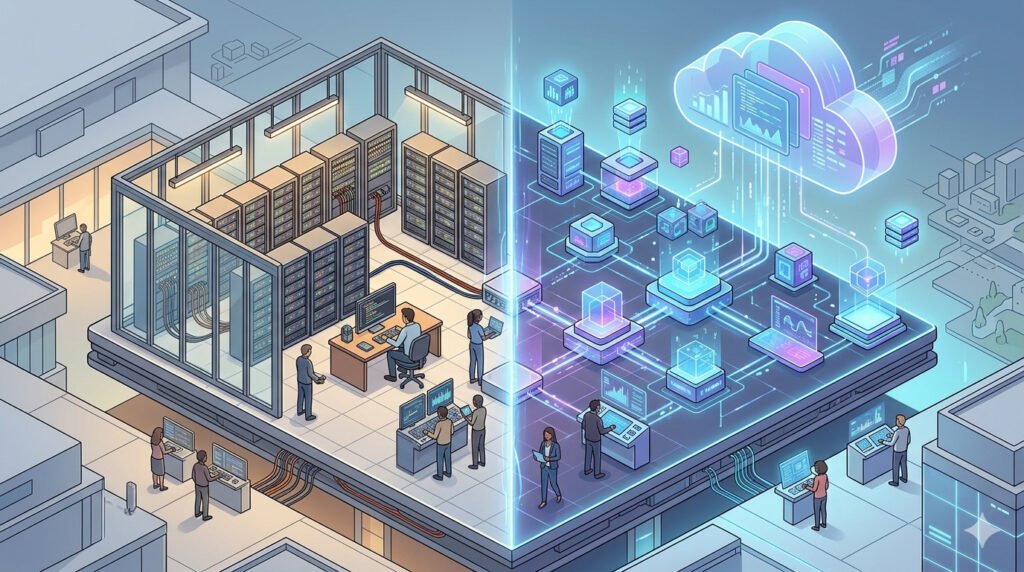
Why Grid Computing Still Matters for CTOs Today
Lessons for the Modern Enterprise CTO: Grid computing introduced engineering solutions to coordinate heterogeneous resources across administrative boundaries. Its scheduling models, authentication federations, and data movement protocols solved problems that reappear in hybrid cloud and multi-edge deployments. Understanding these solutions helps a CTO avoid repeating past mistakes in governance and integration.
Operationally, grid-era projects delivered strong guarantees about job placement, resource accounting, and fault recovery. These capabilities translate to modern needs: predictable batch processing for ML pipelines, fine-grained cost attribution across teams, and orchestrated failover for edge clusters. The engineering disciplines developed for grids – reproducible builds, versioned artifacts, and formalized SLAs – remain directly applicable.
From a risk perspective, grid history teaches that decentralization increases surface area but also enables specialization and scale. A CTO who leverages the grid playbook can design a layered control plane that balances autonomy for local teams with centralized policy enforcement. This balance supports faster delivery without sacrificing security or cost visibility.
Historical Context: Grid to Modern Distributed Systems
Grid emerged in the 1990s and 2000s to aggregate scientific and commercial compute across campuses and companies. The technical stack emphasized secure tunneling, distributed schedulers, and file staging mechanisms. Those components solved coordination and trust problems before ubiquitous virtualization and API-driven cloud services.
As cloud providers standardized APIs and commoditized infrastructure, many grid concepts moved into platform features: quota enforcement became tenant isolation, schedulers evolved into batch services and container orchestrators, and data grids matured into distributed object stores. The transition changed economics, not the underlying engineering trade-offs in latency, throughput, and consistency.
The next shift comes from edge and AI workloads. Edge nodes reintroduce heterogeneity and intermittent connectivity, while AI training and inference push large data flows and specialized accelerators. CTOs should see this as a reassembly of grid-era constraints with new hardware and economics, requiring deliberate architecture rather than defaulting to single-provider designs.
Core Technical Principles That Survive
First, resource abstraction matters. Grid systems exposed compute, storage, and network as negotiable resources with negotiated properties. Modern architectures should keep those abstractions explicit to enable scheduling decisions informed by latency, cost, and data locality.
Second, predictable failure handling is essential. Grids developed retry semantics, checkpointing, and backoff strategies to cope with remote failure modes. These patterns are vital for AI training jobs and edge workloads where long-running stateful operations face transient faults and hardware heterogeneity.
Third, trustworthy identity and accounting remain foundational. Grids solved federated identity and usage accounting to enable cross-institution collaboration. For modern enterprises, consistent identity, immutable logs, and chargeback models enable multi-cloud governance and enforceable SLAs across business units.
Five Practical Lessons from Grid to Cloud and Edge
Lesson one: design for heterogeneity. Assume nodes will differ in CPU, memory, accelerator type, and network. Build scheduling policies that match task profiles to resource capabilities rather than assuming identical execution environments.
Lesson two: separate control plane from data plane. Control operations should be small, resilient, and able to operate under partial network failure. Keep heavy data movement in pipelines that can resume and verify integrity, using checksums and idempotent transfers.
Lesson three: embed observability and cost signals into the scheduler. Grid systems tracked usage for incentives. Today, expose cost per job, per node, and per data transfer to surface trade-offs and enable policy-driven placement that reduces cloud spend without manual intervention.
Lesson four: make security a first-class operational property. Federated trust, fine-grained credentials, and least-privilege execution were grid-era requirements. Apply the same rigor to container runtimes and device attestation at the edge.
Lesson five: prioritize reproducible execution. Capture environment metadata, libraries, and inputs so you can replay jobs across cloud and edge. This simplifies debugging, capacity planning, and compliance reviews.
Infrastructure Roadmap for Modern Enterprises
Start with an inventory and classification of workloads. Capture compute, storage, latency, and data gravity requirements for each application and pipeline. This baseline informs where to place workloads and what level of isolation to enforce.
Establish a layered control plane. Centralize policy, authentication, and billing while allowing local control of node-level scheduling and platform optimizations. Implement versioned APIs so regional teams can upgrade independently.
Deploy a hybrid scheduler that understands accelerators and network topology. Use workload profiles and historical telemetry to drive placement decisions. Integrate preemption and checkpointing for long-running jobs.
Implement resilient data movement patterns. Adopt chunked transfers, integrity checks, and selective replication. Ensure cataloging of data locations and provenance to support compliance and efficient rehydration.
Instrument cost and performance metrics end-to-end. Expose cost per run, latency percentiles, and resource efficiency metrics. Automate policy enforcement when costs exceed thresholds.
Automate least-privilege provisioning and attestation for edge devices. Use short-lived credentials and signed artifacts to prevent drift and reduce attack surface.
Iterate with controlled experiments. Migrate noncritical workloads in phases, measure outcomes, and refine scheduling and data placement policies before broad rollout.
Grid, Cloud, Edge Comparison and Operational Impacts
| Characteristic | Grid | Cloud | Edge |
|---|---|---|---|
| Typical latency | 10s ms to seconds | <10 ms to 100s ms | <1 ms to 100s ms |
| Heterogeneity | High | Medium to high | Very high |
| Control model | Federated | Provider-centric | Local autonomy |
| Data gravity | Large shared datasets | Centralized object stores | Localized, low-bandwidth sync |
Grid systems emphasized federation and negotiated resource sharing, which maps well to multi-tenant enterprise needs where policy and accountability matter. Cloud simplifies management and offers elastic capacity but centralizes control and potentially increases egress cost. Edge reduces latency and improves local resilience but increases operational complexity and security surface.
Operational trade-offs are measurable. For example, moving a 10 TB dataset across regions can cost thousands of dollars and hours of transfer time, while executing compute where data resides reduces cost and latency. Use quantitative thresholds for when to move compute versus move data, and codify them into scheduler policies.
FAQ
Q: How do I decide when to run workloads at edge versus cloud?
A: Use a cost-latency data gravity model. If average request latency must be below application SLOs and data is frequently produced or consumed locally, prefer edge. If the workload needs heavy training or large shared datasets, prefer cloud or on-prem converged sites. Measure traffic patterns for 30 to 90 days to inform policies.
Q: What fault tolerance patterns from grid are most useful for AI workloads?
A: Checkpointing of model state, idempotent training steps, and graceful preemption reduce wasted compute. Combine frequent incremental checkpoints with epoch-aware recovery to balance overhead and recovery time.
Q: How do I enforce cost accountability across federated teams?
A: Implement per-job tagging, automated cost attribution, and daily cost anomaly alerts. Expose dashboards that join scheduler telemetry with billing records. Require approval flows for high-cost instance types or large egress transfers.
Q: Can legacy grid tools be reused in modern stacks?
A: Some components, like workload brokers and data transfer libraries, remain useful. However, integrate them through adapters to modern APIs and container runtimes rather than adopting them wholesale.
Grid computing left a legacy of disciplined engineering practices that remain directly applicable as organizations adopt cloud, edge, and AI infrastructure. The practical lessons described here – heterogeneity-aware scheduling, robust control and data planes, built-in observability, and strong identity and accounting – translate into operational improvements and cost savings.
A CTO should treat the evolution from grid to cloud and edge as a continuum. Apply measured experiments, instrument outcomes, and bake policy into the control plane. This reduces surprise costs and improves resilience as workloads diversify and scale.
Implement the roadmap incrementally, validate decisions with telemetry, and keep reproducibility and security at the center of the design. Doing so will deliver predictable performance, clearer accountability, and a platform that supports future AI and edge innovations.