Introduction: The End of General-Purpose Infrastructure
For the past decade, the enterprise mandate was simple: “Cloud First.” However, as we navigate the 2026 Enterprise Infrastructure Roadmap, that monolithic strategy has fragmented. The rise of Large Language Models (LLMs) and the demand for real-time edge intelligence have pushed general-purpose cloud instances to their limits.
This transition represents a move away from general-purpose virtualization toward a purpose-built, distributed architecture optimized for high-density compute and data sovereignty
“We are entering the era of Purpose-Built Infrastructure. To remain competitive, organizations must now balance three conflicting forces: the raw power of AI clusters, the legal necessity of data sovereignty, and the escalating operational costs of distributed scale. This roadmap provides the architectural blueprints for navigating this new compute paradigm. This evolution from federated resources to purpose-built AI clusters is a direct continuation of our Modern Infrastructure and Distributed Computing: Grid Computing Now Heritage and Mission.”
1. The AI Power Wall: Architecting for H100s and Beyond
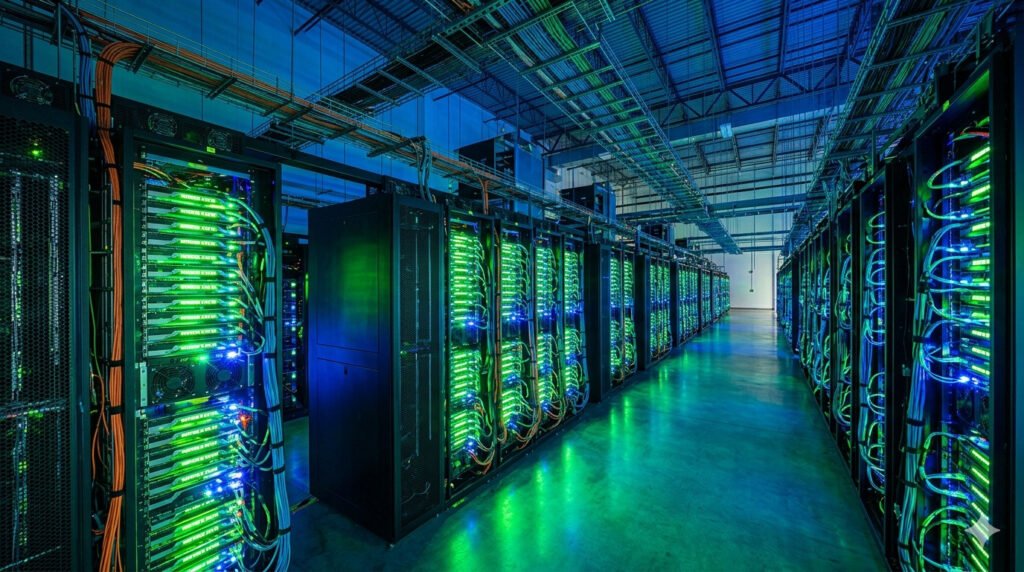
The primary driver of infrastructure change in 2026 is the specialized requirement of AI workloads. Traditional data center designs focused on high-density CPU racks are being overhauled to accommodate the thermal and power demands of modern GPU clusters.
Thermal Management and Liquid Cooling As rack densities exceed 50kW, air cooling is no longer a viable path. We are seeing a massive shift toward direct-to-chip liquid cooling and immersion systems. For the enterprise architect, this means the “Roadmap” is no longer just about software; it is about the physical constraints of the facility.
Specialized Silos vs. Unified Fabrics The challenge for 2026 is avoiding “AI Silos.” Leading organizations are moving toward unified networking fabrics utilizing InfiniBand or Ultra Ethernet to ensure that data can move between training clusters and production environments without the traditional bottlenecks of legacy Ethernet.
2. The Sovereignty Layer: Decentralization as a Legal Requirement
As discussed in our GCN Technical Governance standards, the “Grid” mentality has returned in the form of Sovereign Clouds. National regulations have made it clear: moving data to a centralized global cloud is often a liability rather than an asset.
Jurisdictional Control The 2026 roadmap requires a “Jurisdiction-Aware” architecture. This involves deploying distributed nodes that can process sensitive data locally while only sending anonymized metadata to the central hub. This is a direct evolution of early grid computing protocols, where resource federation was managed across administrative boundaries.
The Hybrid Edge By 2026, the “Edge” is no longer just a collection of IoT sensors. It is a Tier-1 infrastructure component. Enterprises are deploying “Micro-Grids” of compute small, high-performance clusters located within specific legal jurisdictions to ensure compliance with UK and EU data sovereignty mandates.
3. FinOps 2.0: The Fiscal Reality of Distributed Scale
The “Hidden Tax” of the cloud specifically egress fees and the high cost of GPU idling has led to the rise of Infrastructure FinOps. In 2026, a roadmap that doesn’t account for unit-cost economics is destined for failure.
Training vs. Inference Costs The fiscal strategy must differentiate between the capital-heavy phase of model training and the operational-heavy phase of inference. We are seeing a trend toward “Repatriation,” where the initial training happens in the cloud for its elasticity, but the final, high-volume inference is moved to on-premise or colocation grids to stabilize monthly spend.
Predictive Scaling Moving beyond simple auto-scaling, the 2026 roadmap utilizes AI-driven predictive logic to spin up or down resources before the demand spike hits, preventing the “latency tax” that plagues reactive systems.
This fiscal discipline is a cornerstone of the Enterprise Infrastructure Roadmap 2026, ensuring that innovation remains sustainable
4. The Sustainability Mandate: Toward “Net-Zero” Grids
By 2026, the carbon footprint of AI has moved from a Corporate Social Responsibility (CSR) footnote to a core operational constraint. As data centers consume an increasing percentage of the global power supply, “Green Infrastructure” is no longer optional.
Energy-Aware Workload Scheduling The roadmap now includes Carbon-Intelligent Computing. This involves scheduling non-critical training jobs to run during peak renewable energy production hours. By utilizing distributed logic, enterprises can “follow the sun,” shifting workloads between global nodes to capitalize on solar or wind availability.
Hardware Circularity We are seeing a shift away from the “rip and replace” cycle. 2026 is the year of Modular Infrastructure, where individual GPU or memory modules can be upgraded without discarding entire server chassis. This reduces e-waste and aligns with the heritage of resource efficiency established by early grid pioneers.
5. Cyber-Resiliency: Zero-Trust in a Distributed Perimeter
In a world of decentralized nodes and sovereign clouds, the traditional “moat and castle” security model is obsolete. The 2026 roadmap prioritizes Infrastructure-Level Security.
Identity-Defined Infrastructure Every node in the modern grid must possess its own cryptographically verifiable identity. By implementing Zero-Trust Architecture (ZTA) at the hardware layer, organizations ensure that even if a single edge node is compromised, the breach cannot move laterally through the rest of the distributed system.
Post-Quantum Cryptography (PQC) As we look toward the end of the decade, the 2026 roadmap begins the transition to PQC-ready encryption. Ensuring that data at rest and data in transit across the grid is resistant to future quantum-computing-based attacks is a key pillar of long-term data integrity.

6. The Architect’s Evolution: From Manager to Orchestrator
The final, and perhaps most critical, section of the roadmap is the human element. The role of the “IT Manager” has evolved into that of the Distributed Systems Orchestrator.
Bridging the Skills Gap The complexity of managing H100 clusters alongside legacy grids requires a new breed of professional one who understands both the low-level physics of hardware and the high-level logic of cloud-native orchestration. Our GCN Technical Governance emphasizes the need for continuous upskilling in “Full-Stack Infrastructure.”
AI-Augmented Operations (AIOps) The 2026 architect does not manage servers manually. They manage the AI that manages the servers. By deploying AIOps tools, teams can monitor millions of telemetry points across a global grid, identifying potential failures before they manifest as downtime. This shift allows human talent to focus on high-level strategy rather than routine maintenance.
Our commitment to architectural accuracy and vendor neutrality is managed through the GCN Technical Council and Editorial Governance, ensuring every roadmap update meets our Triad of Integrity
7. Optical I/O and the Terabit Networking Frontier
As we hit the “bandwidth wall” in 2026, the roadmap must account for a fundamental shift in how data moves between chips. Traditional copper-based electrical signaling is reaching its physical limits in terms of heat and distance.
The Move to Silicon Photonics In high-performance AI clusters, we are seeing the transition to Optical I/O, where light is used to move data directly from the processor package. This reduces latency by orders of magnitude and allows for “Scale-Across” architectures where data centers kilometers apart can function as a single unified grid.
1.6T Ethernet Adoption The 2026 roadmap officially marks the arrival of 1.6 Terabit Ethernet in the backbone. For the enterprise, this means upgrading core switching fabrics to handle the massive east-west traffic generated by distributed multi-agent AI systems.
8. Agentic Infrastructure: The Rise of Self-Healing Grids
We are moving past simple automation into the era of Agentic Infrastructure. These are autonomous AI agents embedded directly into the orchestration layer (Kubernetes, etc.) that don’t just follow “if-then” rules but make real-time decisions.
Autonomous Resource Negotiation Imagine a grid where the infrastructure “negotiates” for its own power and compute. In 2026, agentic systems can automatically move workloads to different global jurisdictions based on a real-time analysis of spot-pricing, carbon intensity, and hardware health, without human intervention.
Self-Remediation at the Edge For decentralized nodes in remote locations, agentic AI provides a critical “safety net.” If a hardware failure is detected, the local agent can reconfigure the micro-grid to maintain 99.999% uptime, effectively acting as an on-site virtual engineer.
9. Software-Defined Everything (SDx) and Hardware Abstraction
To manage the complexity of 2026’s heterogeneous hardware (a mix of CPUs, GPUs, TPUs, and LPUs), the roadmap relies on a robust Hardware Abstraction Layer.
Decoupling Logic from Silicon The goal for the modern architect is to ensure that software is never “locked” to a specific silicon vendor. Through advanced Software-Defined Infrastructure (SDI), workloads are containerized in a way that they can be “hot-swapped” between an NVIDIA cluster and an ARM-based sovereign cloud node instantly.
Unified Management Planes The 2026 roadmap consolidates the management of storage, networking, and compute into a single “pane of glass.” This reduces the technical debt that usually accumulates when managing “multi-cloud sprawl.”
10. The 2026 Enterprise Infrastructure Roadmap: The Quantum-Classical Hybridization Strategy
While full-scale quantum computing is still maturing, the 2026 roadmap must include a strategy for Quantum-Classical Hybridization.
Quantum-Safe Networking The most immediate concern is Post-Quantum Cryptography (PQC). Enterprises are now auditing their “Grid” to ensure that data encrypted today cannot be decrypted by a quantum computer five years from now.
Algorithmic Offloading Certain optimization problems such as logistical routing within a global distributed system are starting to be offloaded to quantum-as-a-service (QaaS) providers. The roadmap should identify which 5% of your workloads could benefit from this hybrid approach to gain a “mathematical edge” over competitors.
11. Conclusion: 2026 Enterprise Infrastructure Roadmap
The 2026 Enterprise Infrastructure Roadmap is a living document. It represents a shift away from static deployments toward a fluid, intelligent, and highly ethical compute ecosystem. By integrating AI readiness, jurisdictional sovereignty, fiscal discipline, and sustainable logic, the modern enterprise can finally realize the full potential of the global grid. As we continue to update the 2026 Enterprise Infrastructure Roadmap , you can find deeper dives into these topics in our technical archive